Two products with the same formula can behave very differently in different containers. One stays pleasant to use until the last pump; the other changes colour, smell or texture weeks after opening. The difference is often the packaging, which is why it deserves a place in product development from the start rather than at the end.
Packaging is part of the product
UK rules treat the product and its behaviour over time as one question. In Great Britain, the safety report that supports a cosmetic product must consider, among other things, its "physical/chemical characteristics and stability" (OPSS guidance). Stability data produced in a different container from the one you sell in answers a different question.
Packaging also shapes the durability information on the label. A product whose minimum durability is 30 months or less must show a "best used before the end of" date. A product that lasts longer must instead show a period-after-opening symbol, an open jar with a number of months, stating how long it remains safe to use once opened (OPSS guidance, GB). The Northern Ireland guidance sets out the same durability rules (OPSS guidance, NI). Those figures should rest on evidence, and the container is part of that evidence.
Light
Some ingredients are sensitive to light. A 2021 study of retinoids in 12 commercial cosmetic products found that light degradation was more pronounced than temperature-induced degradation. It also found that stability varied with the formulation (Temova Rakuša et al.).
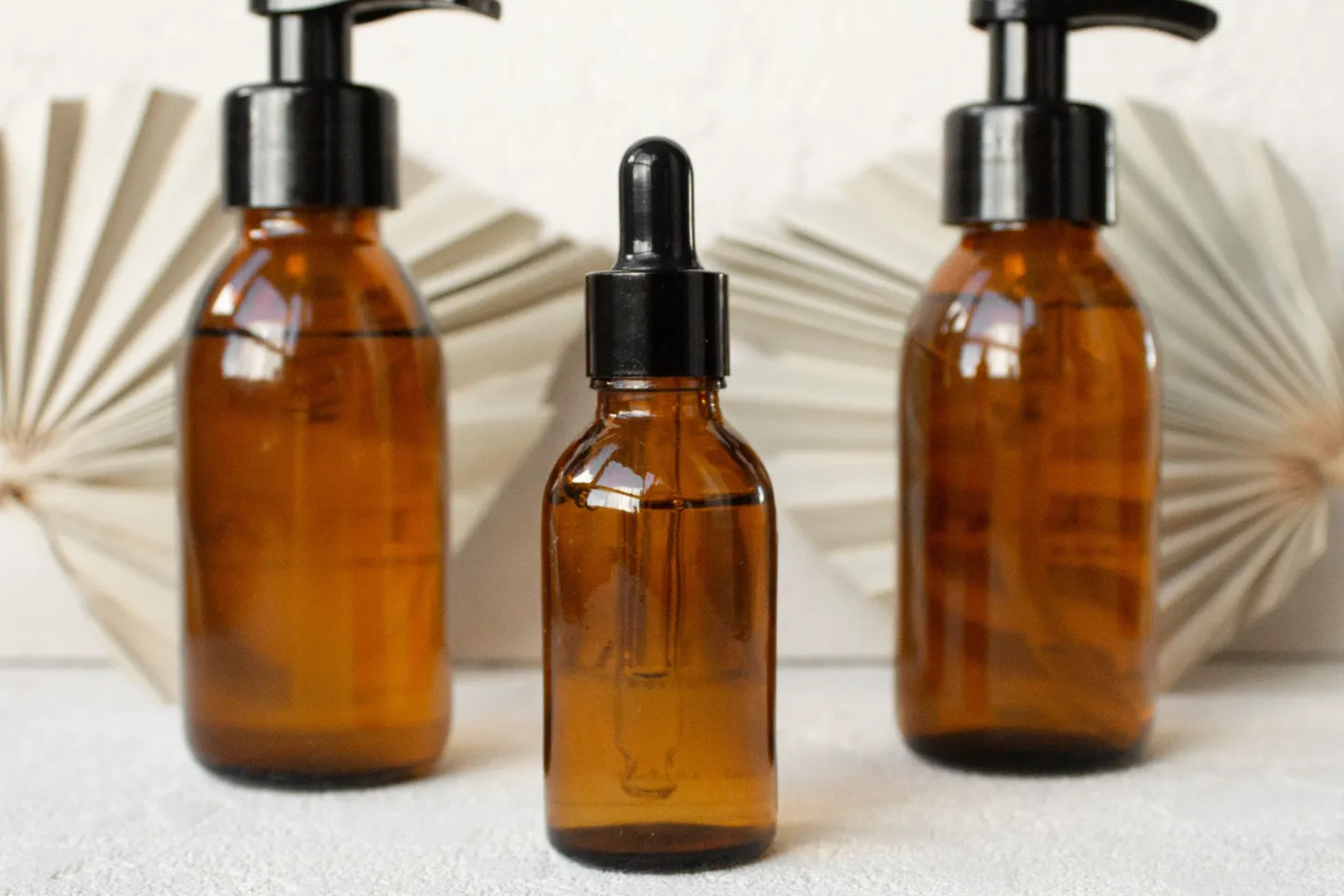
In practice, light-sensitive products are usually filled into opaque or tinted containers, often with an outer carton. Amber glass, pigmented plastics and opaque tubes each reduce light exposure to different degrees. A clear bottle that looks beautiful on a shelf may be the wrong choice for a formula containing retinoids or similar ingredients, whatever the marketing preference.
Air and oxygen
Oxygen is the other common enemy. Vitamin C (ascorbic acid) is a well-known example. A 2024 formulation study opens by describing stability as the main drawback limiting its use in cosmetic products. It reports that a combination of citric acid, tartaric acid and tocopherol reduced degradation significantly in the creams it developed (Shelke et al.). Formulation does much of the work, but packaging determines how often fresh air reaches the product.
A wide-mouthed jar exposes the surface each time it is opened. A dropper bottle admits air with each use. A tube or airless pump limits exposure because the container collapses, or a piston rises, as product is dispensed. None of these guarantees stability. They simply change the conditions the formula has to withstand.
Contamination during use
Every time a consumer opens a product, microorganisms have a chance to enter. How easily they do so depends heavily on the closure. In a classic study, researchers packed unpreserved shampoo and skin lotion into containers with different closures and gave them to volunteers to use normally for two to three weeks. Contamination was found in 71% of the lotions with screw caps, compared with 10% of the lotions with pump tops. For shampoo, the figure was 29% with screw caps and 0% with flip caps (Brannan and Dille).
These were deliberately unpreserved products, so the numbers do not describe ordinary cosmetics. The principle still holds: the closure is part of the product's defence. Preservative systems are tested separately. ISO 11930 sets out a preservation efficacy test and a way of evaluating the overall antimicrobial protection of a cosmetic product (ISO 11930). ISO lists the current edition as due for revision.
Formula and container compatibility
Formula and container can affect each other. Oils and fragrance components may interact with some plastics. Water or volatile ingredients can be lost slowly through container walls. Components of the packaging can migrate into the product, and a formula can stain, soften or crack a component. Pumps and valves can clog with thicker or particle-containing products.
These are reasons, in our view, to test the formula in the actual container, closure and dispensing mechanism intended for sale, and to repeat the check if any component changes. A "compatible" supplier statement about a similar product is not a substitute.
Choosing a dispensing system
| Format | Often helps with | Watch for |
|---|---|---|
| Jar | Thick creams, balms, easy access to the last of the product | Air and finger contact at each use |
| Dropper bottle | Precise dosing of thin serums and oils | Air entry, and the pipette returning to the bottle after contact |
| Standard pump | Hygienic dosing of lotions | Viscosity range, and product left in the dip tube |
| Airless pump | Limiting air exposure | Priming, evacuation of the final contents, component cost |
| Tube | Low air exposure, portability | Material interactions, and residue that cannot be squeezed out |
Dosing matters as well as protection. A pump that delivers a consistent amount helps customers follow usage directions, and a formula that is too thick for its pump is a common source of complaints.
Transport and climate
Products shipped internationally may meet heat, cold, vibration and pressure changes before they reach a warehouse. Temperature swings can separate emulsions or crystallise ingredients. Freezing and thawing can be damaging, and poorly fitted closures can leak. For long supply routes, such as from Korea to the UK, ask what transport conditions the product was tested against and how it is packed for shipping, not only for display.
Stability testing and shelf life
There is no single universal stability protocol. ISO's technical report on stability testing says that, given the variety of cosmetic products, storage and use conditions, it is not possible to define a single way to assess product stability. It is up to the manufacturer to specify and justify the protocol, test methods, specifications and conditions (ISO/TR 18811).
Accelerated tests at raised temperatures are widely used because they are quick. They do not always predict real life. The retinoid study mentioned earlier concluded that real-time stability studies were needed instead of the more frequently used accelerated studies (Temova Rakuša et al.). A sensible approach, in our view, is to treat accelerated results as an early indication and confirm shelf life with real-time data.
Sustainability trade-offs
Packaging sustainability is full of intuitive claims that do not always survive analysis. No material or format is environmentally superior in every case.
- Reuse depends on actual reuse. The Environment Agency's life cycle assessment of supermarket carrier bags illustrates the general point. Heavier, reusable options carry a higher production impact, which is only repaid if they are actually reused enough times (Environment Agency). Refillable cosmetic packaging faces the same arithmetic.
- Recycled content needs testing. Recycled plastics can differ from virgin material in colour, odour or consistency. Treat a change of material as a change of packaging, and check compatibility again.
- Regulation affects cost. In the UK, Plastic Packaging Tax applies to plastic packaging containing less than 30% recycled plastic. Businesses that manufacture or import 10 tonnes or more of finished plastic packaging components, within the periods HMRC sets out, must register (HMRC). Separately, extended producer responsibility for packaging places reporting and cost obligations on larger UK packaging producers, with thresholds based on tonnage and turnover (GOV.UK).
- Protection is part of sustainability. A lighter container that lets a product spoil early may create more waste than it saves.
The honest approach is to weigh these factors for a specific product and route to market, and to avoid broad environmental claims that cannot be supported.